
Natural Hair Treatment vs Hair Transplant (2026): Which Actually Regrows Hair?
Last updated on August 20, 2026
We get asked this almost every week at our Toronto clinic: “Do I really need surgery, or can I just fix this with oils and supplements?” It’s a fair question, and honestly, the answer depends on where you are in your hair loss journey.
Here’s the short version. Natural treatments can slow down hair loss and improve the health of the hair you still have. But once a follicle has actually died — which happens gradually with genetic pattern baldness — nothing topical or natural is bringing it back. That’s where a hair transplant comes in. It’s the only method that physically moves living follicles into the bald or thinning area, so the regrowth is real and permanent.
Let’s get into the details.
What Do We Mean by “Natural Hair Treatment?
This covers a pretty wide range of things people try before considering surgery:
- Oils like castor oil, rosemary oil, or onion juice
- Supplements — biotin, iron, zinc, that kind of thing
- Scalp massage or microneedling to get blood flow going
- Diet changes, better sleep, lower stress
- Ayurvedic and herbal formulations
We’re not going to tell you these don’t work at all. For some people — especially those dealing with temporary shedding from stress or a nutritional gap — they genuinely help. The issue is they were never designed to reverse genetic baldness, and expecting them to is where people get disappointed.
What Actually Happens During a Hair Transplant
A hair transplant takes healthy, balding-resistant follicles from a donor area (usually the back of your scalp) and relocates them to the thinning or bald spot. At our Toronto hair transplant clinic Most patients today go with FUE (Follicular Unit Extraction), which removes individual follicles one at a time, though FUT still has its place for larger areas needing more coverage.
Because those donor follicles are genetically programmed not to fall out, the hair they grow once transplanted sticks around for good.
So Which One Actually Wins?
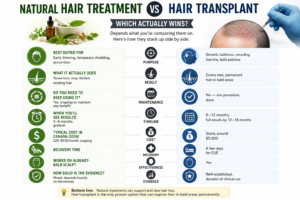
Depends what you’re comparing them on. Here’s how they stack up side by side:
| Factor | Natural Hair Treatment | Hair Transplant |
|---|---|---|
| Best suited for | Early thinning, temporary shedding, prevention | Genetic baldness, receding hairline, bald patches |
| What it actually does | Slows loss, may thicken existing hair | Grows new, permanent hair in bald areas |
| Do you need to keep using it? | Yes, ongoing to maintain any benefit | No — one procedure, done |
| When you’ll see results | 3-6 months, gradual | 6-12 months, full results by 12-18 months |
| Typical cost in Canada (2026) | $20-$150/month, ongoing | Starts around $5,500 |
| Recovery time | None | A few days for FUE |
| Works on already-bald scalp? | No | Yes |
| How solid is the evidence? | Mixed, depends heavily on the remedy | Well-established, decades of clinical use |
Who Should Go With Natural Treatment First?
Honestly, if you’re catching this early — maybe you’ve noticed more hair in the shower drain lately, but there’s no visible bald spot yet — natural treatment plus a proper medical approach (we’ll get to that) is a reasonable place to start. You’re not out anything by trying, and it can genuinely buy you time.
Who Actually Needs a Transplant?
If you’re already seeing a receding hairline, a thinning crown, or patches where the scalp shows through, no amount of rosemary oil is fixing that. At that point the follicles in that area aren’t dormant, they’re gone. A transplant is the only realistic path to getting visible hair back there.
Why Not Both?
This is genuinely what we recommend to a lot of patients. Use something like Growth Factor/PRP therapy or LLLT to protect and strengthen the hair you still have, and get a transplant to rebuild what’s already gone. It’s not an either/or decision for most people — it’s about using the right tool for the right part of the problem.
Bottom Line
Natural treatments have a real role, particularly early on. But they have a ceiling, and that ceiling is: they can’t regrow hair from follicles that are no longer active. A hair transplant is still the only method that gives you permanent, visible regrowth once you’re past that point.
If you’re not sure which category you fall into, that’s honestly what a consultation is for — it’s hard to self-diagnose this one accurately.
Frequently Asked Questions
1. Can natural remedies really regrow hair?
They can improve scalp condition and slow further shedding, but they won’t bring back hair from follicles that have already stopped producing. Think prevention, not restoration.
2. How long does it take to see results from a hair transplant?
Most people start to see initial growth around the 3-month mark. More noticeable results are between 6-12 months. Full results generally emerge at 12-18 months.
3. Is a hair transplant permanent?
Yes. The follicles come from an area of your scalp that’s genetically resistant to balding, so the hair they grow stays put.
4. What is the cost of hair transplant in Canada 2026?
Procedures generally begin at about $5,500 depending on the number of grafts you require.
5. Should I try natural treatments before getting a hair transplant?
If you’re early on and still have thinning (not bald) areas, yes — natural treatment alongside something like PRP can help. If you already have bald patches or a receded hairline, that area needs a transplant to see actual regrowth.
Not sure which stage you’re at? Book a free consultation with our team in Toronto, Mississauga, or Oakville — we’ll give you a straight answer, not a sales pitch.

About The Author
SEO.AEO


FUE Hair Transplant from $76/Bi-Weekly
Minimally invasive hair transplant to achieve refined, long-lasting, natural results from $76/Bi-Weekly With Zero Deposit
